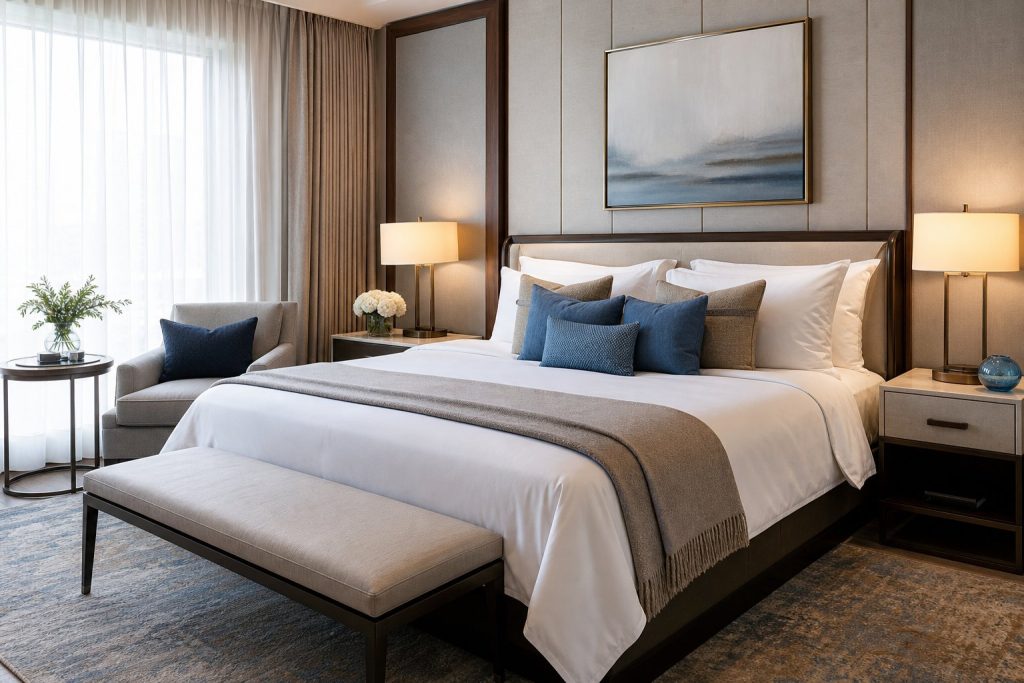
Knowing how to decorate a hotel room comes down to balancing visual appeal with practical function, since guests judge a space by how comfortable it feels within the first few minutes of entering.
Effective hotel decor starts with the guest’s needs — good lighting, clear surfaces, comfortable bedding, and accessible outlets — then layers in color, texture, and art that reflect the property’s brand and location. Decorative choices that ignore function tend to frustrate travelers, while purely practical rooms often feel forgettable.
The following sections cover how to decorate a hotel room from a designer’s perspective: room planning, materials and finishes that hold up under frequent turnover, and the ideas that deliver the strongest return on guest comfort and satisfaction scores.
Key Takeaways
- Room design should begin with how guests actually use the space, not with aesthetics alone.
- Decor choices work best when they reinforce the property’s identity and local setting.
- Durable materials and thoughtful details sustain comfort across high guest turnover.
Plan the Room Around Guest Needs and Brand
Effective hotel room interior design begins with measurements, sightlines, and an honest assessment of what guests actually do in the space: sleep, work, unpack, and unwind. From there, decisions about color scheme, furniture scale, storage, and artwork all trace back to a single design direction tied to brand identity.
Assess the Existing Layout, Condition, and Constraints
Before selecting a single finish, the room needs to be documented: floor area, ceiling height, window position, door swing, and the location of outlets, HVAC units, and plumbing walls.
These fixed elements determine where the bed can sit and how much circulation space remains. A minimum of 24 to 30 inches of walking clearance around the bed keeps the room usable.
Condition matters as much as dimensions. Worn carpet seams, chipped case goods, water-stained ceilings, and dated bathroom tile should be logged and prioritized, since new decor over damaged surfaces reads as neglect.
Constraints also include budget per key, fire code, ADA requirements, and how quickly the room must return to inventory.
Define a Cohesive Color Palette and Design Direction
A neutral color palette—warm greige, oatmeal, soft taupe—gives modern hotel room design longevity and photographs well across booking platforms.
Earthy tones such as clay, olive, and sand add warmth without dating the room quickly. Deeper accents in navy, forest, or charcoal work well on headboards, drapery, and upholstered benches.
A practical approach is the 60-30-10 split:
| Share | Application | Example |
|---|---|---|
| 60% | Walls, carpet, large surfaces | Warm neutral plaster or paint |
| 30% | Bedding, drapery, upholstery | Textured linen in earthy tones |
| 10% | Art, pillows, lighting, hardware | Brass, ceramic, abstract art |
Boutique hotel design can push further with patterned wallpaper or lacquered millwork, while modern luxury properties tend to rely on material contrast—stone, walnut, bouclé—rather than strong color.
Prioritize Comfort, Privacy, and Practicality
The mattress, pillows, and linens absorb most of the guest’s judgment, so budget should follow that hierarchy before decorative extras.
Blackout curtains on a quiet track system are non-negotiable, ideally layered with a sheer for daytime light control. Reading lights on both sides of the bed, dimmable ambient lighting, and a nightlight path to the bathroom cover the practical needs.
Outlets and USB ports belong at the nightstand, desk, and near the luggage bench—not behind furniture.
Privacy deserves equal attention. Glass partitions between bathroom and sleeping area look striking but require frosted panels, sliding screens, or integrated blinds for shared-occupancy comfort.
Surfaces should also survive daily housekeeping: performance fabrics, sealed stone, and hardware that resists cleaning chemicals.
Maximize Compact Rooms With Flexible Furniture and Storage
Small rooms gain floor area when furniture leaves the ground. Floating nightstands and a floating desk open up sightlines and simplify vacuuming.
Multifunctional furniture earns its place:
- An upholstered bench that works as luggage storage and seating
- A desk chair that doubles as a bedside or lounge chair
- A headboard with an integrated ledge instead of a bulky nightstand
- Wall-mounted mirrors positioned to reflect a window or cityscape view
Hidden storage keeps surfaces clear—drawers under the bed platform, a closet with pull-out shelving, and a niche for the minibar and safe.
Wardrobes with sliding or pocket doors avoid the swing clearance a hinged door demands. In rooms under 250 square feet, a glass partition can separate the bathroom without closing off daylight.
Create a Distinctive Sense of Place
Rooms that feel interchangeable are forgettable, and artwork is the fastest way to fix that. Commissioning local art—photography of the neighborhood, prints from a nearby studio, textile work by regional makers—connects the room to its city.
Abstract artwork suits properties that prefer a quieter look, particularly in oversized single pieces above the bed.
Beyond art, place can be signaled through material choices: regional stone in the bathroom, locally milled timber, or ceramics from a nearby workshop.
Framing the view matters too. If the room faces a cityscape view, furniture should orient toward the window, and window treatments should pull fully clear of the glass.
Build a Polished, Comfortable Guest-Room Experience
A guest room reads as polished when the bed anchors the space, textiles soften every hard surface, and lighting shifts easily from morning to night. Seating, natural materials, and a few well-chosen details complete the room without crowding it.
Start With a Restful Bed and Statement Headboard
The bed occupies the most visual space, so it sets the tone for everything else. Designers typically build it with plush bedding: a medium-weight duvet, a quilted coverlet, and two pillow layers — sleeping pillows in front, larger Euro shams behind.
The headboard carries the style. Options worth comparing:
| Headboard style | Effect | Works well with |
|---|---|---|
| Tufted or upholstered | Soft, hotel-suite polish | Velvet, linen |
| Arched | Contemporary, gentle lines | Neutral walls, wood accents |
| Carved wood | Traditional texture | Warm wood tones |
| Canopy bed | Enclosed, suited to a romantic getaway | Sheer drapery panels |
Keep the frame proportional — a headboard should extend a few inches past the mattress on each side.
Layer Window Treatments, Textiles, and Soft Furnishings
Windows need two functions: light control and privacy. Pairing sheer curtains with blackout drapes on a double rod handles both, letting natural light filter through by day while blocking it fully at night.
Hang rods close to the ceiling to make the wall feel taller, and let panels break just at the floor.
Textiles carry the layered textures that make a room feel finished. Mix a linen duvet with a velvet lumbar pillow, a cotton throw, and a silk or satin accent for shine.
Throw pillows work best in odd numbers — three to five across a queen bed. Add a low-pile rug under the bed’s lower two-thirds so bare feet land on something soft.
Use Layered Lighting for Every Time of Day
Single overhead fixtures flatten a room. Layered lighting solves this with three tiers working together.
- Ambient lighting — a ceiling fixture, pendant lights, or a chandelier on a dimmer for general brightness
- Task lighting — reading lamps or swing-arm wall sconces at the bedside, positioned so light falls on the page, not the eyes
- Accent and mood lighting — a floor lamp beside a chair, backlighting behind the headboard, or LED strips under the bed frame
Statement lighting fixtures deserve one clear focal point per room; a sculptural pendant or crystal chandelier competes with itself if repeated.
Bulbs matter as much as fixtures. Choose 2700K warm white for soft lighting, and put every layer on a dimmer or lamp switch guests can reach from bed.
Add Seating, Surfaces, and a Functional Work Zone
Even a small room benefits from somewhere to sit that isn’t the bed. A chaise lounge, an armchair with an ottoman, or two chairs facing a window creates a seating nook that makes the space feel like a suite.
Surfaces follow function:
- Side table beside each seat, roughly arm height, for a drink or book
- Nightstands with a drawer, at mattress height, plus an accessible outlet
- Luggage bench at the foot of the bed
- Desk or console at 29–30 inches, with a chair that tucks fully underneath
A work zone needs three things guests notice immediately: a level surface, a task lamp, and power within reach. Adding a wall mirror above the desk pushes light back into the room.
Bring In Natural Materials and Low-Maintenance Greenery
Natural materials keep an upholstered room from feeling heavy. Natural wood nightstands, a rattan chair, marble or stone lamp bases, and jute or wool rugs add texture without added color.
Wood paneling behind the bed, or a few simple wood accents on shelving and frames, introduces warmth that pairs well with white bedding.
Greenery finishes the job. Indoor plants suited to low-effort care include:
- Snake plant — tolerates low light, infrequent watering
- Pothos — trails from a shelf or dresser
- ZZ plant — handles neglect well
- Succulents and air plants — small scale, ideal for a desk or bathroom ledge
Group potted plants in threes at varying heights, and choose ceramic or woven planters over plastic.
Finish With Thoughtful Decorative Details and Smart Controls
Details are what guests remember. A tray on the dresser corrals a carafe, glasses, and a small stack of books. Candles in glass vessels, plus a signature scent through a reed diffuser, give the room a consistent, recognizable smell.
Art should sit at eye level, around 57–60 inches to center, and relate to the room’s palette rather than compete with it.
Smart technology handles the practical side:
- Bedside panel or app control for lights and curtains
- Smart plug on lamps for scheduled dimming
- USB-C and standard outlets at the bed and desk
- Thermostat set to a clear, adjustable range
A full-length mirror, robe hooks, and a luggage rack round out the essentials.
Frequently Asked Questions
Hotel room decorating usually comes down to a few practical decisions: how much to spend, what can be transported easily, and which surfaces can hold decorations without causing damage. The answers below cover budget approaches, occasion-specific setups, packing lists, and when outsourcing the work makes sense.
How can I decorate a hotel room on a budget?
Battery-operated LED string lights, tissue paper garlands, and balloons deliver the biggest visual change for the lowest cost. A pack of 100 latex balloons often costs under $10, and an air pump removes the need for helium.
Dollar stores and craft store clearance sections carry reusable banners, table confetti, and paper lanterns. Buying items that pack flat also keeps luggage costs down for those flying.
Guests can skip fresh flowers, which wilt quickly, in favor of a single stem in a hotel water glass or a small potted plant that travels home afterward.
What are the best birthday decoration ideas for a hotel room?
A balloon garland taped along the headboard wall frames photos well and takes about 30 minutes to assemble. Number balloons marking the age work as a focal point near the desk or window.
Other options that suit hotel rooms:
- A “Happy Birthday” banner strung across the mirror or curtain rod
- Confetti scattered on the desk rather than the carpet, which is easier to clean up
- A small cake or cupcakes with battery candles, since open flames trigger smoke detectors
- A gift stack arranged on the luggage bench
- Photos clipped to string lights as a timeline of past years
How can I create a romantic hotel room setup for a couple?
Lighting sets the tone more than anything else. Turning off overhead fixtures and using flameless candles or warm string lights softens the room immediately.
Rose petals work on the bed, floor, and bathroom counter, though silk petals avoid staining light-colored linens. Many hotels sell rose petal packages directly, which saves the effort of sourcing them.
A chilled bottle in an ice bucket, two glasses, and a playlist through a portable speaker complete the setup. Requesting a room with a bathtub or balcony in advance adds options.
What items do I need to decorate a hotel room?
A basic kit covers most setups:
| Item | Purpose |
|---|---|
| Painter’s tape or removable adhesive strips | Hanging banners without damaging paint |
| Battery LED lights and candles | Lighting that complies with fire policies |
| Balloons and a hand pump | Volume and color |
| Scissors and fishing line | Cutting and stringing decorations |
| Trash bags | Cleanup before checkout |
Optional additions include a small tablecloth to cover the desk, framed photos, and a portable speaker.
How can I make a hotel room feel special for someone?
Personal details matter more than quantity. A handwritten note on the pillow, their favorite snacks arranged on the desk, or a printed photo from a shared trip registers more than a large balloon display.
Calling the front desk ahead often helps. Many hotels will place a card, a plate of dessert, or a bottle of wine in the room at no charge for birthdays, anniversaries, and honeymoons if asked in advance.
Small comfort items also work well: a candle to take home, bath salts, or a book they mentioned wanting.
Can I hire a hotel room decoration service near me?
Yes. Balloon artists, event stylists, and dedicated hotel room decoration companies operate in most mid-sized and larger cities, with prices typically starting around $150 and rising based on balloon volume and setup complexity.
Booking requires coordination with the hotel. The property must approve outside vendors, grant room access before check-in, and confirm what adhesives and materials are permitted.
Some hotels offer in-house packages through their concierge or events team, which removes the access issue entirely. Asking about these during reservation is the fastest route.


