Hurricane season has a way of complicating travel plans in Florida, Mexico, and the Caribbean, and travelers often find themselves weighing an uncomfortable question as a storm approaches: stay put in the hotel, or get out while the roads are still open.
A well-built hotel located outside of a mandatory evacuation zone is generally a reasonably safe place to ride out a hurricane, since larger resorts are typically constructed to withstand high winds and often have backup generators, stocked water, and staff trained in emergency procedures — but the safety of any hotel depends heavily on its distance from the coast, its elevation, and whether local officials have ordered an evacuation.
Storm surge and flooding, not wind, cause the majority of hurricane-related deaths, which is why a beachfront property may pose more risk than a building a few miles inland.
Knowing how to evaluate a property, when to leave, and how to protect oneself inside a hotel room makes a significant difference in the outcome. The sections below cover how travelers in hurricane-prone destinations can make that call and what hurricane preparedness looks like when home is a rented room.
So, is a hotel safe during a hurricane? Let’s find out more about that in this article.
Key Takeaways
- Evacuation orders and proximity to the coast should determine whether a traveler leaves or stays.
- Interior rooms on lower-to-middle floors away from windows offer the most protection during a storm.
- Travelers in hurricane-prone regions should confirm a hotel’s emergency plans and generator capacity before booking.
Decide Whether To Leave Or Remain At The Property
Whether a hotel is a reasonable place to ride out a storm depends on three factors: what officials are directing residents and visitors to do, where the building sits in relation to storm surge and flood zones, and how prepared the property actually is. Guests who evaluate all three before landfall have far better options than those who wait until roads close.
Follow Official Alerts And Evacuation Directives
A hurricane watch means hurricane conditions are possible within 48 hours. A hurricane warning means they are expected within 36 hours — the point at which preparations should already be complete.
Guests should monitor NOAA and the National Hurricane Center directly rather than relying on secondhand updates. Wireless Emergency Alerts (WEA) push evacuation notices to mobile phones automatically, and local authorities issue county-level orders that hotels may not communicate promptly.
A mandatory evacuation order applies to hotel guests exactly as it applies to residents. Staying is not a permitted alternative, and emergency services will not respond once conditions deteriorate.
Anyone leaving should identify the designated hurricane evacuation route early and confirm whether an emergency shelter is accepting arrivals, since contraflow lanes and fuel shortages develop quickly.
Assess Location, Flood Risk, And Building Resilience
Storm surge causes the majority of hurricane fatalities, and beachfront hotels sit directly in its path. Guests should check the property’s address against FEMA flood maps and local surge zone designations — often labeled A through E — before deciding anything.
Building construction matters. Many modern high-rise hotels in Florida and the Gulf Coast use reinforced concrete and impact-rated glazing designed for hurricane-force winds, which gives them better structural integrity than low-rise wood-frame motels.
Height cuts both ways, though. Wind speeds increase with elevation, so floors above roughly the tenth are exposed to stronger gusts, while ground floors and parking levels flood first.
The general guidance: run from water, hide from wind. A structurally sound inland hotel is a reasonable shelter; a well-built hotel inside a surge zone is not.
Ask Hotel Management About Its Emergency Plan
Guests should speak with hotel management before the storm rather than during it. Useful questions include:
| Question | Why it matters |
|---|---|
| Is the property in an evacuation zone? | Determines whether staying is even legal |
| Will staff remain on site? | Some hotels close and require guests to leave |
| Is there a backup generator, and what does it power? | Elevators and air conditioning often are not covered |
| Where is the designated interior shelter area? | Usually stairwells, ballrooms, or interior corridors |
| What is the cancellation and refund policy during warnings? | Policies vary widely by brand |
Guests should also ask about water and food reserves, since resupply can be interrupted for several days after heavy rain and flooding.
A property that cannot answer these clearly is signaling its level of preparation.
Once a hotel confirms guests are sheltering in place, the priority shifts to positioning away from windows, keeping supplies within reach, and preparing for interruptions to power and water. Staff instructions, combined with a personal emergency kit, determine how comfortable and safe the wait becomes.
Move To A Safer Interior Area
Most hotels identify designated safe zones before landfall, typically interior corridors, ballrooms, stairwells, or windowless meeting rooms on lower floors.
Guests in rooms with balconies or floor-to-ceiling glass should ask to be relocated. Flying glass causes a significant share of hurricane injuries, and upper floors experience stronger wind speeds than ground level.
If relocation is not offered, occupants can improve their own hotel room by:
- Closing curtains and blackout drapes to catch glass fragments
- Moving into the bathroom or an interior closet during peak winds
- Placing mattresses against the door or over the bathtub as a shield
- Keeping shoes on to avoid cuts from debris
In storm surge zones, staying on a floor above expected flood levels but below the highest floors offers a reasonable compromise.
Build A Personal Emergency Kit
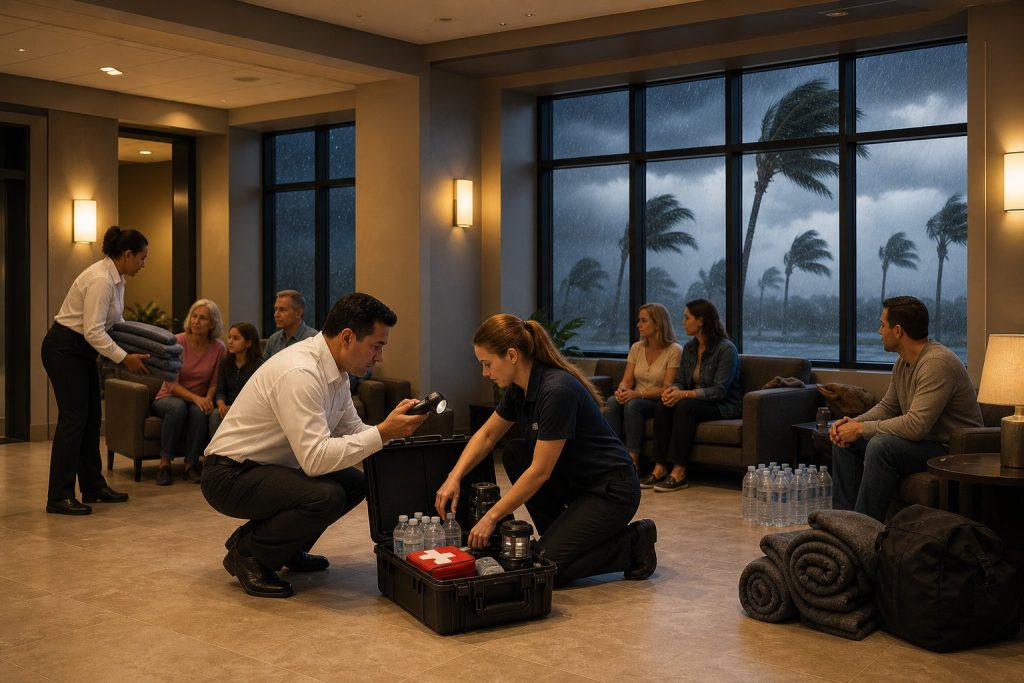
Hotels supply some emergency supplies, but quantities run short when a property is full. A personal go-bag removes that dependency.
| Item | Recommended Amount |
|---|---|
| Bottled water | 1 gallon per person, per day, for 3 days |
| Non-perishable food | Granola bars, nuts, canned goods with a pull tab |
| First aid supplies | Bandages, antiseptic, pain relievers |
| Flashlight | One per person, plus extra batteries |
| Medications | 7-day supply minimum, in original bottles |
| Documents | ID, insurance cards, travel insurance policy number |
A power bank, a portable radio, and cash in small bills also matter once card readers stop working.
Guests should fill the bathtub and ice buckets with tap water before the storm arrives for washing and toilet flushing.
Manage Power, Water, And Communication Disruptions
Power outages are common, and many hotels run backup generators that support only hallway lighting, elevators, and front desk systems, not individual guest rooms.
Elevators may be shut down entirely. Guests with mobility limitations should notify staff early so they can be placed on a lower floor.
Cell networks often become congested. Text messages and messaging apps usually get through when voice calls fail, so travelers should send a short status message to family and then conserve battery.
Water service can stop or require boiling. Bottled water remains the safest option until local authorities lift any advisories.
Downloading offline maps, the FEMA app, and local emergency alerts ahead of the storm keeps information accessible without a data connection.
Take Precautions After The Storm Passes
Calm conditions can signal the eye of the hurricane rather than the end of it. Guests should remain in the safe zone until hotel management or local officials confirm the all-clear.
After that:
- Treat every downed power line as live and stay at least 30 feet away
- Avoid standing water, which may hide debris, sewage, or electrical current
- Photograph any damage to belongings for a travel insurance claim
- Check with the front desk about road conditions, airport status, and boil-water notices
Flights and rental car pickups are frequently delayed for days. Contacting airlines and confirming whether the hotel can extend the reservation should happen quickly, since rooms fill with displaced residents and utility crews.
Frequently Asked Questions
Hotel safety during a hurricane depends on the building’s construction, its location relative to storm surge zones, and whether local authorities have ordered an evacuation. The answers below cover shelter locations, floor selection, evacuation decisions, and what guests should pack.
Can you stay in a hotel during a hurricane?
Yes, guests can stay in a hotel during a hurricane, provided the property is outside a mandatory evacuation zone. Many modern hotels in hurricane-prone regions are built to withstand high winds, particularly those constructed after Florida’s 2002 building code updates.
However, staying is only advisable when local emergency management has not ordered evacuation for that area. Hotels near the coast in storm surge zones are frequently included in mandatory evacuation orders, and remaining there is both unsafe and, in some jurisdictions, a violation of local emergency directives.
Some hotels close entirely ahead of a major storm and require guests to check out. Others remain open and shelter both guests and staff.
What is the safest place to shelter in a hotel during a hurricane?
The safest location is an interior room or hallway on a lower floor, away from all windows and exterior doors. Stairwells, interior corridors, and windowless meeting rooms or ballrooms are common choices.
Guests should put as many walls as possible between themselves and the outside. Bathrooms in interior rooms work well because they typically have no windows and are surrounded by plumbing walls.
Avoid:
- Rooms with balconies or sliding glass doors
- Corner rooms, which face wind pressure from two directions
- Lobbies and atriums with large glass panels
- Elevators, which can lose power at any moment
Many hotels designate a specific assembly area in advance. Front desk staff can identify it on request.
Which hotel floor is safest during a hurricane?
Floors two through four generally offer the best balance. Wind speed increases with height, so upper floors in a high-rise experience noticeably stronger gusts than ground level.
The ground floor carries a different risk: storm surge and flooding. In coastal areas, water can enter first-floor rooms and lobbies even when the building itself remains structurally sound.
For a hurricane where flooding is the main concern, guests should move above ground level. For a wind-dominant storm inland, lower floors are preferable.
Should you evacuate from a hotel when a hurricane warning is issued?
Guests should evacuate if local officials issue a mandatory evacuation order for the hotel’s zone. A hurricane warning alone does not automatically require leaving, but it does mean hurricane conditions are expected within 36 hours.
The decision should follow guidance from county emergency management rather than the hotel. Coastal properties in surge zones A and B are typically evacuated first.
Guests who decide to leave should do so early. Roads become congested, fuel runs short, and airports suspend operations well before landfall.
Do hotels have hurricane evacuation plans and emergency procedures?
Most hotels in hurricane-prone states maintain written emergency plans covering evacuation routes, shelter-in-place procedures, generator operation, and guest communication. Chains such as Marriott, Hilton, and Hyatt require properties to file storm preparedness protocols.
These plans commonly include boarding or shuttering windows, moving outdoor furniture indoors, stocking water and non-perishable food, and stationing staff on-site through the storm.
Guests can ask the front desk or general manager directly about the property’s plan, backup power capacity, and whether the building has been designated a public shelter. Independent and smaller properties vary more widely in preparedness.
What should you bring if you need to shelter in a hotel during a hurricane?
Guests should assemble supplies before the storm arrives, since hotel amenities and nearby stores may be unavailable for several days.
Essentials include:
- Three days of drinking water, roughly one gallon per person per day
- Non-perishable food that requires no cooking
- Prescription medications and a basic first aid kit
- Flashlight and extra batteries — not candles
- Portable phone charger or power bank
- A battery-powered or hand-crank radio
- Copies of identification, insurance cards, and reservation details
- Cash, since card readers and ATMs fail without power
Guests should also fill the bathtub or sink with water for sanitation use and keep shoes accessible in case of broken glass or debris.